

Hall effect systems
ORDER NOW
FastHall measurement capability contained in a complete characterization platform
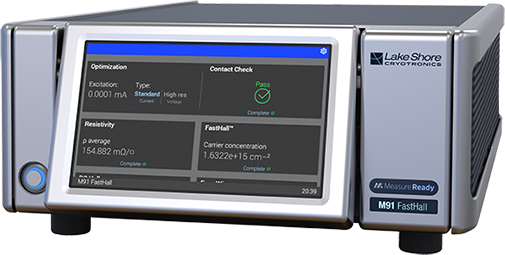
The MeasureReady™ M91 FastHall™ measurement controller is a revolutionary, all-in-one Hall analysis instrument that delivers significantly higher levels of precision, speed, and convenience to researchers involved in the study of electronic materials.
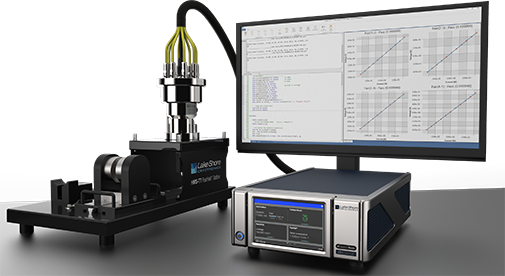
And now this novel capability is available as part of the FastHall Station, an integrated, high-precision tabletop measurement system for simplified Hall measurements and less experimental setup.
The FastHall Station includes a Windows® 10 PC, 1 T permanent magnet, high-precision sample holder, and all the necessary software and cabling to provide a range of measurement capabilities, including sample resistances up to 1 GΩ and mobility measurements down to 0.01 cm2/V s — making it a great choice for labs studying low-mobility materials.
 | Widest measurement range
| |
| Completely integrated mini-system solution
| |
| Increased productivity and flexibility
|
Watch the demo video:

ORDER NOW
A new approach to Hall measurement
The MeasureReady M91 is a revolutionary, all‑in-one Hall analysis instrument that delivers significantly higher levels of precision, speed, and convenience to researchers involved in the study of electronic materials.
Featuring Lake Shore’s patented* new FastHall measurement technique, the M91 fundamentally changes the way the Hall effect is measured by eliminating the need to switch the polarity of the applied magnetic field during the measurement. This breakthrough results in faster and more accurate measurements, especially when using high-field superconducting magnets or when measuring very low-mobility materials.
*Protected by US patent number 9797965. Other patents pending.
| Simpler and more convenient
| |
| Makes better measurements, faster
| |
| Cost-effective
|
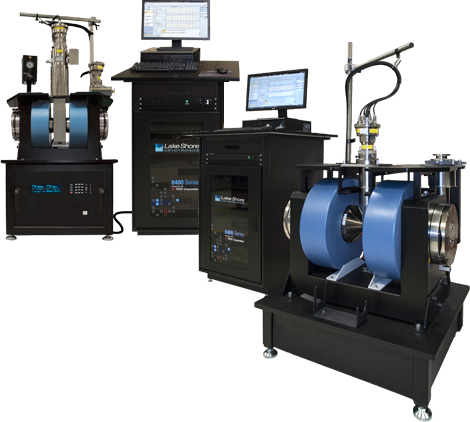
- Ideal for variable temperature measurement and mobilities from 1 to 106 cm2/V s
- Optional AC field extends mobility measurement range down to 10-3 cm2/V s
- Maximum DC fields to 1.67 T (8404) and 2.25 T (8407)
- Optional AC fields to 1.18 T (8404) and 1.31 T (8407)
- Standard resistance range of 0.5 mΩ to 10 MΩ
- High resistance option widens range to 200 GΩ
- Low resistance option significantly reduces resistance noise floor
- Temperatures from 15 K to 1273 K
- Also available as an option for the CRX-VF cryogenic probe station