Sign In

Cable


Ultra miniature coaxial cable - type C, SC, SS

  • Very flexible
  • Long flex life
  • Available in three configurations:

C - solid copper center conductor, drain wire, and aluminized/polyester shield

SC - stranded copper conductors

SS - stranded 304 stainless steel conductors


Ultra miniature coaxial cable is for use when a strong and flexible cable is needed. Type C and SC are recommended when low conductor resistance is a prime consideration. Type SC and type SS are mechanically the most flexible, due to their braided construction. Type SS is recommended for use when both shielding and low thermal losses are important. For technical specifications on types SS, C, SC and SR, click here.
    Nominal attenuation (dB/m)
C(1) SC SS
1 MHz 0.092 0.108 0.569
5 MHz 0.167 0.240 1.272
10 MHz 0.224 0.344 1.799
15 MHz 0.257 0.421 2.850
20 MHz 0.294 0.486 2.545
50 MHz 0.427 0.769 4.031
100 MHz 0.623 1.090 5.694
500 MHz 1.312 2.453 12.749
1 GHz 1.886 3.488 18.048
2 GHz 2.625
5 GHz 7.968 40.526
1 Type C has a bandwidth to at least 3 GHz - above that, the aluminum/polyester becomes a less effective shield
Thermal Conductivity of Copper Units are W/(m • K)
  4 K 20 K 30 K 77 K 300 K
RRR8 = 20 122 719 870 502 397
RRR = 100 460 2460 2070 533 407
8 RRR = Residual Resistance Ratio
 

Semi-Rigid Coaxial Cable - Type SR

  • Easily bent, coiled, stripped, machined, soldered, or connected without impairing performance
  • Solid center conductor provides the optimum geometrical surface for transmission
  • Low standing wave ratio (SWR) with a dielectric controlled to exacting tolerances
  • Low thermal conductivity
  • (˜4.5 W/(m • K) at 4.2 K)9
  • Matching minimizes reflective power loss
  • Provides shielding isolation for virtually no extraneous signal pickup
  • Tubular outer conductor offers minimum size and maximum conductor integrity; stainless steel jacket can be soldered directly to circuit boards
  • 37 AWG, silver-plated copper-weld steel center conductor
Coaxial Cable Frequency Response Specifications
Frequency
(GHz)
Insertion loss
dB/m (dB/ft)
Power CW
(20 °C, sea level, W)
0.5 4.43 (1.35) 7.6
1.0 6.27 (1.91) 5.3
5.0 14.09 (4.30) 2.4
10.0 20.01 (6.10) 1.7
20.0 28.45 (8.67) 1.2
This cable transmits and receives high-speed, high frequency microwave signals. Typically used for transmission lines in cryogenic-vacuum test systems
To remove the outer conductor:
  1. Score jacket
  2. Bend at score until shield kinks, fatigues, and breaks
  3. Slide off outer conductor
Extreme caution must be used in this process to avoid damage to the coax
9 Thermal conductivity at low temperatures is dominated by the copper cladding around the center conductor

CryoCable™ - Type CRYC

  • Robust: the NbTi wire cores are strong and fatigue resistant, and the cable overbraid of 304 stainless steel adds significant strength and crush resistant
  • Low heat leak due to all metal alloy and Teflon® construction
  • Solderable: the CuNi wire surface is easy to solder with conventional rosin fluxes
  • Cryo-compatible: all Teflon® (PFA) insulation is heat strippable for ease of preparation
A robust, 4-wire cable for use in cryogenic environments to room temperature is now available. The cable is designed around 32 AWG (203 µm) diameter superconductive wires consisting of a NbTi core (128 µm diameter) and a Cu-10% Ni jacket.
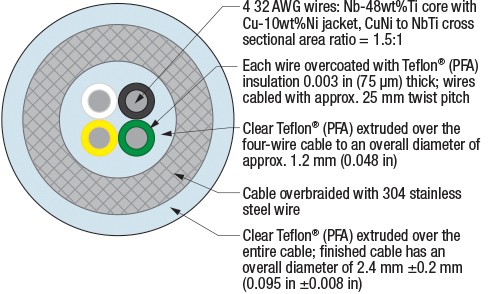
The cable is constructed as follows:
  1. 4 superconductive wires are overcoated with 75 µm (0.003 in) thick Teflon® (PFA) of the following colors: white, yellow, green, and black.
  2. 4 lengths of Teflon®-jacketed wire, one of each color, twisted together with a twist pitch of about 25 mm (1 in). Teflon® (PFA) is extruded over the 4 wires to a total diameter of about 1.2 mm (0.048 in).
  3. Cable is overbraided with 304 stainless steel (5 × 36 AWG). The overbraid is tight and presents complete visual coverage.
  4. Teflon® (PFA) extruded over the entire cable for protection of the metal overbraid. The total finished cable is nearly round with a diameter of about 2.4 ±0.2 mm (0.094 ±0.008 in).
                                              Temperature (K)
  295 77 4.2
Wire resistance (Ω/m) 9.2 8.4 010
Overbraid resistance (Ω/m) 0.90 0.64 0.62
Thermal conductivity —
entire cable assembly (W/(m•K))
7.6 2.8 0.17
10 Superconducting